From the Medina to Berlin: The Story of Ouuma
A silver ring from the Medina of Tunis, a quiet rebellion against a consultancy career, and a chore jacket on its fifth version. Meet Ouuma.
Berlin. By way of the Medina of Tunis.
There is a version of this story that starts with a business plan. There wasn't one. I would rather start with a ring.
Every time Marouane Ben Belfort went on holiday to Tunisia, he walked into the Medina of Tunis and found his silversmith. He'd bring a design, the silversmith would realise it, and Marouane would fly home with a piece of jewellery that existed nowhere else. That was the entire operation for years, a ritual rather than a brand. Then, somewhere between a job in management consulting and the first year with his first child, the ritual needed a name. He called it Ouuma.

At first it was only jewellery. Clothing arrived later, out of the same curiosity rather than a plan to expand, and these days Ouuma reads increasingly as a fashion label that happens to still make jewellery, not the other way round. The name itself is older than any of it: Ouuma comes from Umm (or Oum, as it's written in Tunisia), the Arabic word for mother.
The clothes are a mix that shouldn't quite work on paper, preppy, tailoring, function, military and workwear, but does, because the thread holding it together isn't a mood board, it's a map. Marouane's roots are German and Tunisian, and Ouuma is the bridge he's building between them, and by extension between the Maghreb and the Europe north of it, France and Italy especially. It is, by his own description, a personal search for his own roots, made physical and wearable.

Nowhere is that bridge more literal than on the scarves, the Rania silk scarf (€120) and the Tunis scarf (€105). Both are built from an escape map of downtown Tunis from 1935, originally drawn by the US Army in 1942 and redrawn by Ouuma into something you can wear around your neck instead of folded in a soldier's pocket. It is a strange object to turn into a product, a wartime evacuation route as a silk print, and it is exactly the kind of strange that makes sense once you know where Marouane is actually from and where he actually lives now.
He is upfront that this is also personal in a less geographic way. Buying into Ouuma means being taken along on a journey into the Maghreb and back into Europe, and watching a brand, and by extension a person, grow in public. Marouane calls it giving insight into his own vita. The clothes follow the same logic. They are not arriving as a finished, locked-down collection. They are arriving the way a life does, piece by piece, each one slightly different from the last, eventually adding up to something coherent.

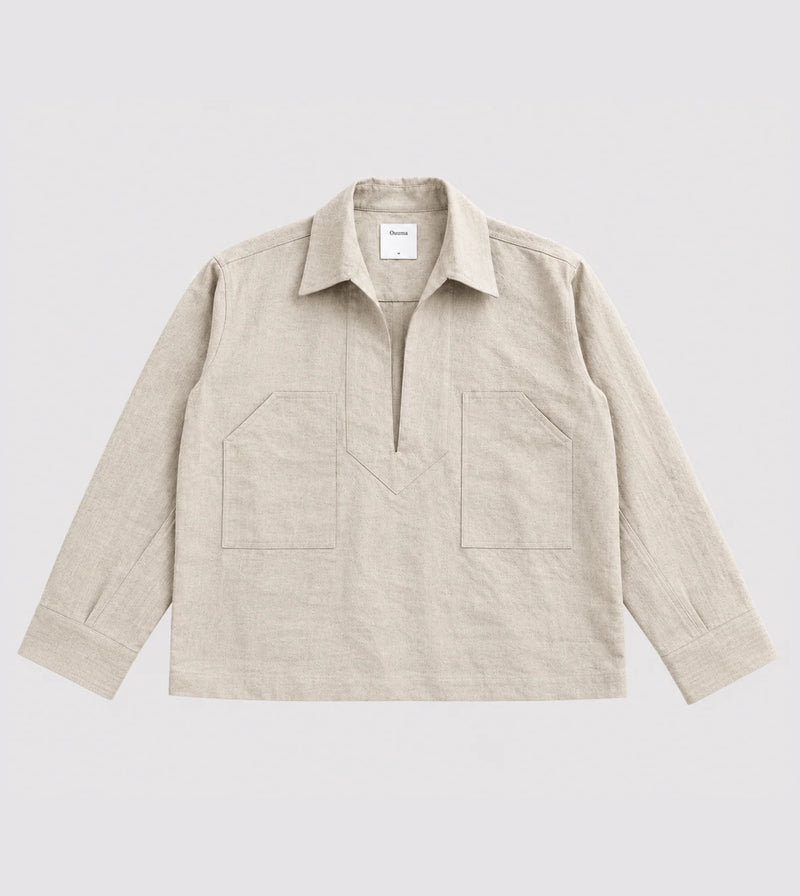
Take the chore jacket. The version sold today is the M-25, Model 2025 (€269), and it is the fifth attempt, not the first. Four earlier versions were made, worn, and quietly retired before this one earned the name. The sixth, the M-26 in dark blue herringbone, is already in development, a further-refined version of a jacket Marouane still doesn't consider finished. That is more or less the house rule: a product is never done, only currently published. Even pieces already in the shop keep getting upgraded underneath the same name.
Not everything is in the shop, though, and that's deliberate. The kimono, cut from reclaimed military tent canvas, and the jewellery are kept limited on purpose. The kimono in particular never goes up for sale publicly; it's sold only to friends of the brand, off-list. The chore jacket and the FS-261 fisherman shirt (€249), by contrast, are made in larger numbers, meant to actually be worn into the ground rather than kept as a trophy in someone's closet.
Marouane describes the pieces as a complement to a wardrobe someone already has, Liebhaberstücke (German for “collector’s pieces”), pieces for people who already love clothes, not a starter kit for people who don't. The pricing is moving the same direction on purpose, gradually into a higher bracket, closer to where the quality actually sits rather than where a young label is expected to price itself.
To me, it feels a bit like buying a young painter's work early in his career. Pieces of this quality, some of them handmade in Germany, are rare at these prices, and that is only possible because the brand is still so young. Don't expect it to stay that way for long: more and more people are hearing about the beauty of these pieces and the passion behind them.
"When you acquire a piece of Ouuma, you acquire a piece of its story."
His own reference points are exactly as specific as you'd hope: Gauthier Borsarello, Aaron Levine, Stone Island, Margiela, Fortela, late-90s and early-2000s Helmut Lang, Rubato. It is a list that trusts you to already know why those names belong in the same sentence.
Marouane Ben Belfort, Ouuma's founder, is in his mid-thirties, an architect by training, living in Berlin, where Ouuma keeps a small studio open to visitors on Saturday afternoons. It is the kind of detail that tells you everything about the scale he's operating at: a one-man architecture-adjacent jewellery-and-clothing label you can still just walk into, if you know when to show up.
More is coming out of Portugal soon: a shirt, a waistcoat, a coat, and two more chore jackets, gradually filling out a wardrobe rather than chasing a single hero product.